Get this template
Selim Fırat
Desinfecta AG
/23
Introducing our cutting-edge AI-powered CV generator tool Cubra, designed to revolutionize the way you create and showcase your professional credentials. In a world where first impressions matter, our tool leverages the latest advancements in artificial intelligence to provide you with a streamlined, efficient, and highly effective CV creation experience.
Client:
Mindnow
My Role:
Sr. Product Designer
Year:
2022-2023
Service Provided:
Product Design (UI/UX), Web Design, Usibility Test, Empathy Maps, User Flows, Flowcharts, Information Architecture
The Challenge
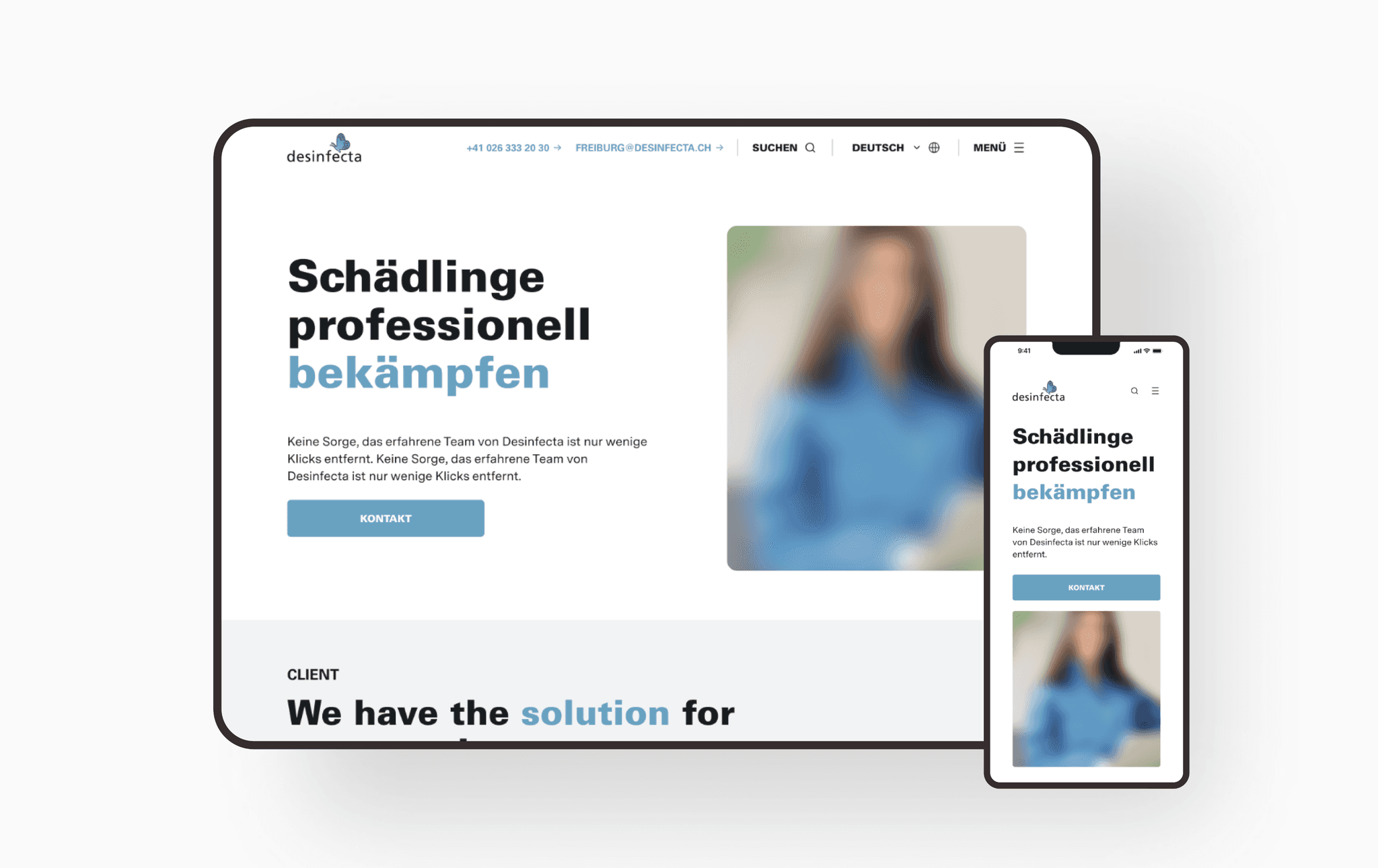
Creating and designing for a pest control company that serves both professional businesses and private homes comes with its own set of challenges. One major hurdle is helping customers quickly identify the pest they’re dealing with—without requiring lengthy conversations or spending 10+ minutes trying to describe the problem.
Another challenge is building a user-friendly interface that works for people with diverse professional backgrounds and levels of technological proficiency. Ensuring that the website is accessible and intuitive for users ranging from tech-savvy individuals to those who rarely use digital tools is essential for widespread adoption and overall success.
Aditionally, enabling users to find accurate, relevant information about pests—and understanding how critical this knowledge is—is one of the most important aspects of the redesign process.
Lastly, the website has grown organically for many years, it no longer provides an optimal overview for its users.

Process
Ensuring a user-friendly interface introduces another layer of complexity. The experience must support both private and business customers, accounting for a wide age range and differing levels of digital familiarity. Increasing customer acquisition in the private sector by 20% requires an interface that feels intuitive, accessible, and efficient for all users.
Streamlining contact options—whether finding an email, locating a phone number, submitting a form, or accessing the PestPilot and DPM login—plays a crucial role in reducing friction and guiding users toward the right action with minimal effort.
Designing a clear and reliable Pest Identification feature further enhances the user journey by helping individuals quickly understand the issue they are facing, ultimately improving decision-making and reducing uncertainty.
Additionally, demographic insights can inform the visual and interaction design. In the private sector, the majority of users are female, while business-facing interactions are primarily male-dominated. Balancing these differences without compromising brand consistency is essential for delivering a cohesive, inclusive experience.
Taking all of these considerations into account, I created a series of wireframes to explore the most effective, streamlined, and user-focused solutions for the platform.
Solution
User-Friendly Interface Optimization:
To support both private and business customers across a wide age range, the platform must prioritize intuitive interaction patterns. This can be achieved through simplified navigation, clear hierarchy, scalable typography, and accessible components. Conducting usability tests with participants of varying digital proficiency ensures that the interface remains inclusive, efficient, and capable of driving a 20% increase in private-sector customer acquisition.
Frictionless Contact Pathways:
Reducing friction in reaching support or services is essential. This solution includes designing a unified “Contact & Access” hub that consolidates all actions—email discovery, phone access, form submission, and direct entry points to PestPilot and DPM. By presenting these options clearly, users can quickly identify the correct path, decreasing drop-offs and improving conversion rates.
Enhanced Pest Identification Tool:
To support users who may be uncertain about their pest problems, the platform should offer a structured identification tool. This involves guided questions, image-based hint cards, and a recommendation engine that narrows possible pests based on user input. This improves decision-making and reduces the need for long explanations, providing clarity and confidence for both private and business users.
Demographic-Aware Design System:
A design system informed by demographic insights ensures that both primary user groups feel represented and supported. Subtle adjustments in tone, imagery, and content structure can appeal to predominantly female private customers while maintaining a more utilitarian approach for primarily male business users. These variations must remain consistent with the core brand identity to maintain trust and cohesion.
Iterative Wireframing and Validation:
Based on the diverse requirements, multiple wireframes were created to explore the most efficient and user-centered solutions. Through iterative prototyping, A/B testing, and scenario-based evaluations, the platform can continuously evolve, ensuring the final design addresses user needs with clarity and precision.
In summary, these solutions prioritize accessibility, efficiency, and clarity, ensuring a seamless experience across diverse user groups. By optimizing the interface, reducing friction in contact pathways, enhancing identification tools, applying demographic insights, and embracing an iterative design approach, the platform is positioned to significantly improve user satisfaction and drive measurable growth—particularly in private-sector customer acquisition.

Outcome
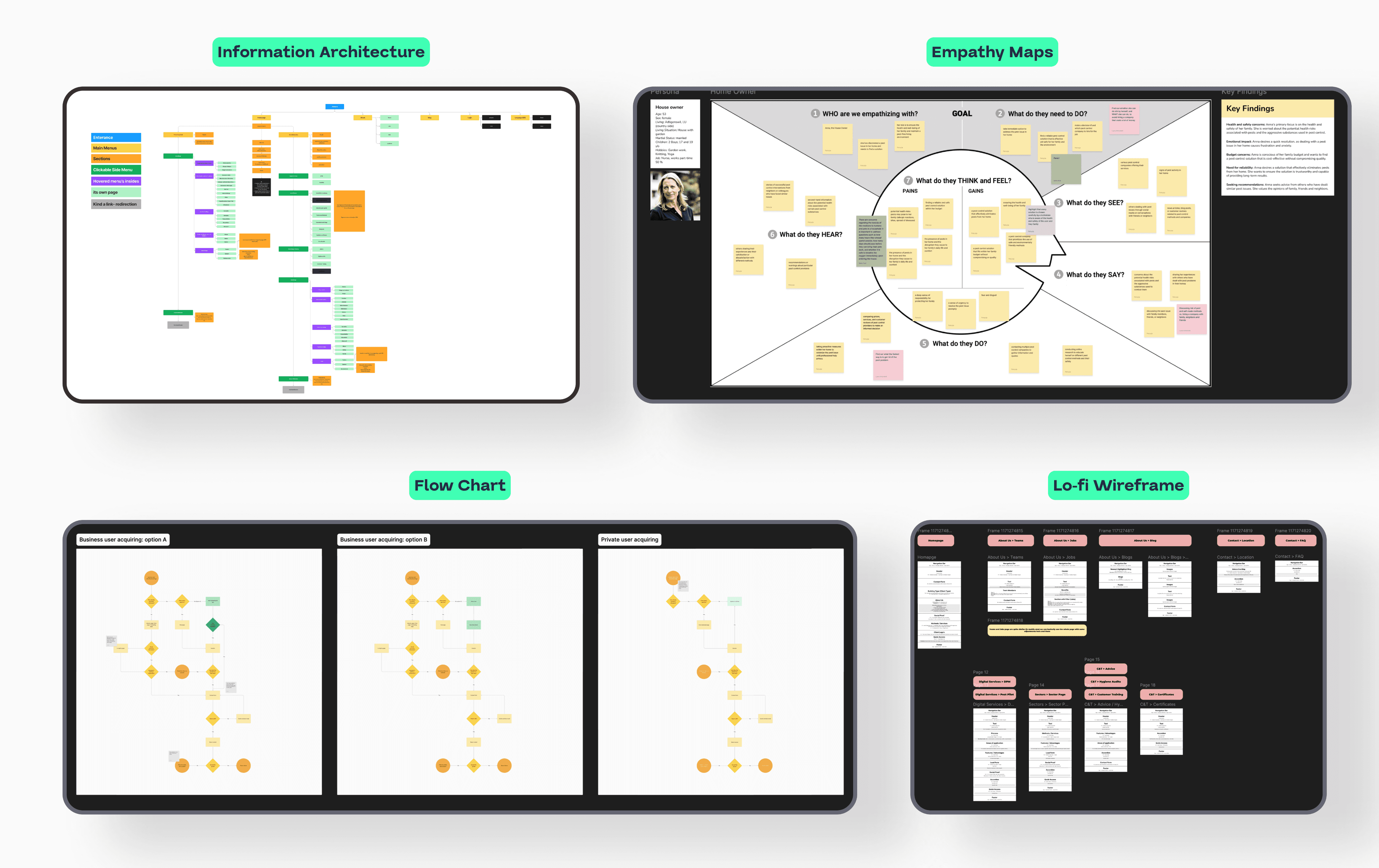
Through a structured UX process, the redesign led to a clearer, more intuitive experience that successfully aligned with both private and business customer needs. The journey began with empathy mapping, allowing us to deeply understand user motivations, frustrations, and demographic differences. These insights directly informed our design decisions and ensured the platform spoke to the expectations of a broad audience—from tech-savvy business users to private customers with varying levels of digital familiarity.
To address the site’s navigation issues, I conducted extensive research and created a highly detailed Information Architecture that reorganized the entire website. This new structure eliminated confusion, reduced dead ends, and established clear pathways for discovering services, identifying pests, and making contact.
Using this foundation, I developed multiple user flows and flowcharts to capture each key scenario, from pest identification to booking a service. These flows helped validate the logic early on and ensured every step was purposeful and streamlined.
Both lo-fi and hi-fi wireframes were created to explore different layout variations, interaction patterns, and content hierarchies. These wireframes guided discussions with stakeholders and helped refine key components such as the Pest Identification tool and the unified Contact section.
To ensure the design choices met the needs of each demographic group, I conducted usability testing on both wireframes and final UI screens. Users across private and business segments tested various layouts, allowing us to measure clarity, ease of navigation, and task completion. Feedback from these tests directly shaped the final interface and confirmed which design variations performed best for each demographic.
As a result, the platform now offers an intuitive, inclusive, and efficient experience that supports confident decision-making and reduces friction across all core actions. This process laid a robust foundation for improving customer engagement and contributed to the strategic goal of increasing private-sector acquisition by 20%.